I engage in projects that foreground collaboration as a long-form practice of shared thinking, making, and learning. Many of these are academic-creative in nature: co-curated working groups, artist interview series, and performance-centered curatorial collaborations. I am particularly drawn to projects that invite continued return, rethinking, and refinement over time. These collaborations reflect my commitment to research that fosters cross-cultural dialogue, embraces interdisciplinary exchanges, and cultivates new modes of cultural and scholarly exchange across theatre, performance, media, and Asian studies.
Inter-View Project
VR often promises to offer a unique and individualized experience, similar to to immersive theatre. To move beyond this frame, I am conducting interviews with artists to gain an intersubjective understanding of VR performance. Here, the inter-view is a methodology to “see between” and “see each other” across layers of experience both in physical and virtual realms. As I navigate the evolving VR technology and its possibilities (and limitations) in performance, I propose these interviews as duets in academic discourse.
I conducted an interview with South Korean artist Kwon Hayoun in a virtual museum I created using a social VR platform. Meeting as virtual avatars, we discussed topics related to what I call VR dramaturgy, from designing physical and virtual spaces, understanding technical affordances and limitations of VR technology, to choreographing movements for both performers and audience especially in the context of Kwon’s participatory VR performance, XXth Attempt Towards the Potential of Magic. The full interview is published in Critical Stages (December 2024).
The second interview is with Singaporean artist Ho Tzu Nyen. We discuss the dramaturgy of ghostly voices in his participatory VR work Voice of Void, as well as VR as a medium to address complex histories and unresolved tensions in Asia. The full interview is considered for TDR: The Drama Review.
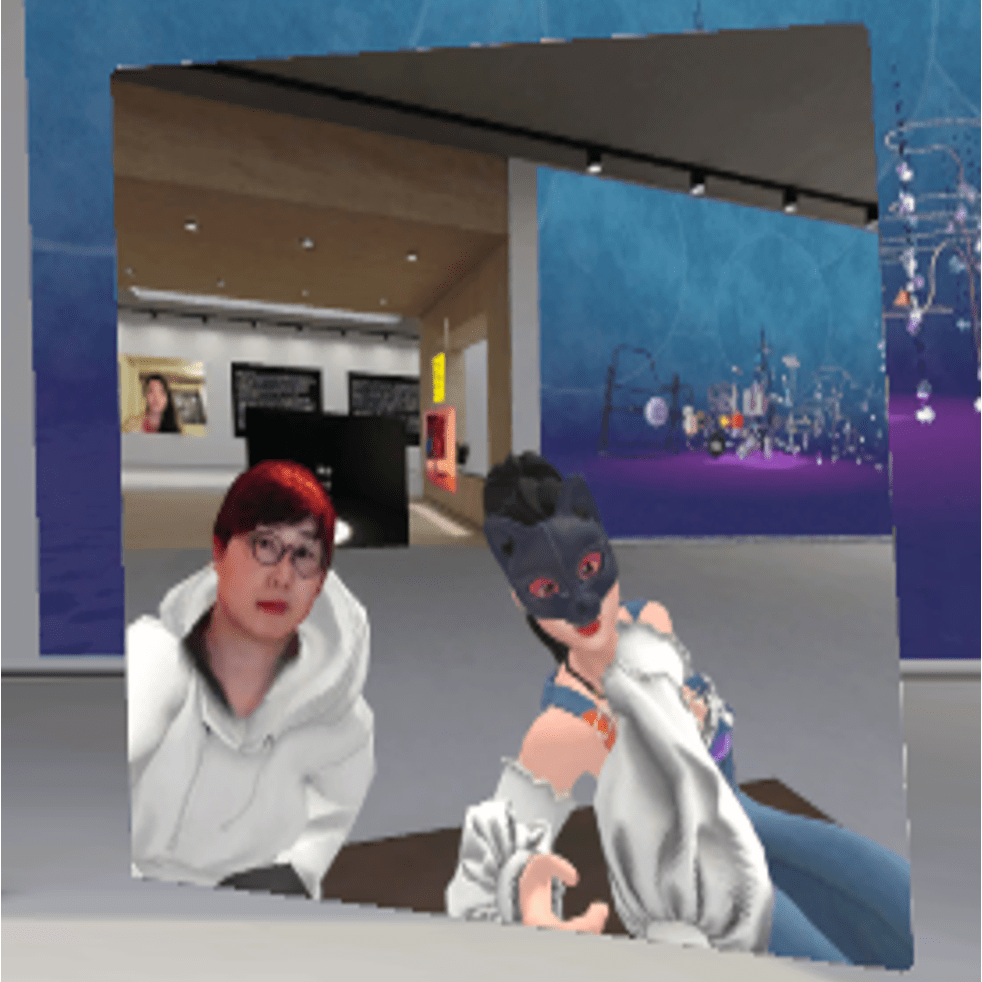
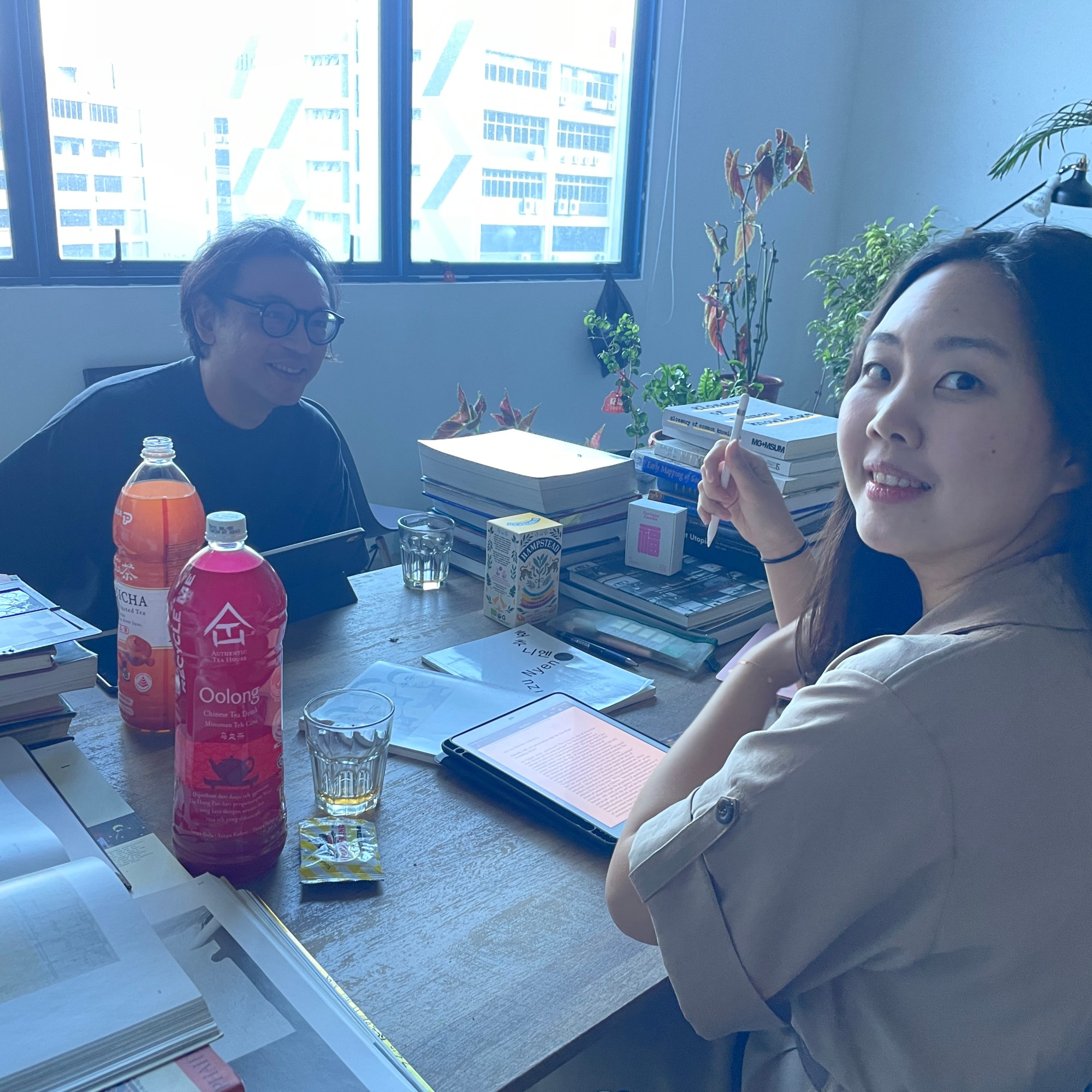
[Left] Virtual selfie with Hayoun Kwon as 3D avatars in a VR gallery
[Right] Photo with Ho Tzu Nyen at the artist’s studio in Singapore
Curating PERFORMANCE AND VIRTUAL REALITY (VR) WORKING GROUP
In 2022, I co-founded and co-organized the inaugural Performance and Virtual Reality (VR) Working Group at the American Society for Theatre Research (ASTR) with Dr. Katherine Mezur (UC Berkley). We are joined in subsequent years by Prof. Laura Hyunjhee Kim (UT Dallas) in 2023, Prof. Walter Byongsok Chon (Ithaca College) in 2024, and Prof. Peter Eckersall (The Graduate Center, CUNY) in 2025 as co-conveners.
We curated the working group as a laboratory to foster discussions about virtual/ immersive technologies, theatre, and performance. We sought experimental and daring research and practices from scholar-artists delving into the potential of VR as well as the possibilities of theatrical and performative interventions into current VR discourses. The group functions as an ongoing, sustainable platform for critical exchange and is developing an edited volume or special journal issue on performance and virtual reality. As reflected in the theme of each year, we are interested in exploring the intersection of VR, performance, and the concept of the “wild.” Expand the details below for each year’s conference themes and include a brief summary of the corresponding calls for papers.
Degenerative Times and Generative Places (2025) – Denver | Virtual Session
In times of crisis, can virtual reality (VR) and immersive media navigate the terrains of trauma, history, and collective memory? There is a need to critique the market-driven, “sleek” fantasy of VR. Our group will rethink VR technology through multiple modalities that address the complexities of times and places, inviting capacious frameworks from diverse fields such as religion, healthcare, migration studies, militarism, and beyond. Among the questions we will field together are: What are generative elements in VR, how do they emerge, and what processes shape their development? What elements are refused, left behind, or allowed to decay in the process of creation? How might these acts of degeneration inform or critique the generative processes they accompany? Rather than viewing generative and degenerative as opposing dichotomies, we invite research into how generation and degeneration might coexist and shape each other. Participants may approach VR through a critique of the industry and technology; historical and philosophical perspectives on “virtual reality”; or a specific VR case study ranging from video games and music videos to dance, media art, medical applications, pornography, pedagogy, and religious practices.
Virtual Wilderness: Immersive Performances and Technologies in Wild Times (2024)- Seattle | Virtual Session
In our 3rd year of Performance and Virtual Reality (VR) Working Session, we invite you to think with us about VR and immersive technologies and their (im)possible connections to wilderness. How can wilderness challenge virtual worlding? Is there a VR wilderness? Wilderness often conjures inhospitable, dangerous, even mystical terrains of wild human and non-human living things. It also symbolizes uncharted territories: unexploited, timeless, awe-inspiring. However, wilderness is as much about external landscapes as it is about the unexplored territories of our collective and individual consciousness. We invite you to experiment with virtual reality and wilderness across all these messy layers of meaning and beyond. Further, we envision VR and immersive technology as a type of wilderness in itself, a potential realm of danger, harm, and overwhelm. For the complete rationale, please visit: https://www.astr.org/page/24_working_sessions#vws06
VR’s Wild Hope (2023) – Rhode Island | Virtual Session
Wild is a collective interaction with possibilities anchored and unanchored. It takes us to imaginaries that disconnect with real, live, and presence, a different unknown. What does “VR’s wild” do to hope? What does hope/lessness demand of VR? How do simulated realities, even if bound to an individual’s experience within the confines of the virtual, provoke empathy and human and non-human connections? For the complete rationale, please visit: https://www.astr.org/page/23_working_sessions#ws27
Catastrophe’s Bodies and Wild Sensorium (2022) – New Orleans
We will explore different arenas of VR as technological and artistic medium and examine how VR allows us to rethink the paradigms of here/there, self/others, and physical/virtual bodies through distant and intimate encounters with catastrophes. How does VR crack our corporeal “hearts” and shatter sense-making into inexhaustible layers of wild sensations? How does the virtual materialize experience? If catastrophe performs undoing and disordering, does VR have the potential to transform us into “wild things” (Jack Halberstam)? How do artists and creators employ VR systems to reimagine, rebuild, and rethink possible worlds in the aftermath/futures of disasters, like the pandemic, climate disasters, terror attacks, and wars? For the complete rationale, please visit: https://www.astr.org/page/22_WorkingSessions#ip5
Curatorial Practice: Cross Cultural Dialogues on Technology, Queerness, and Spirituality
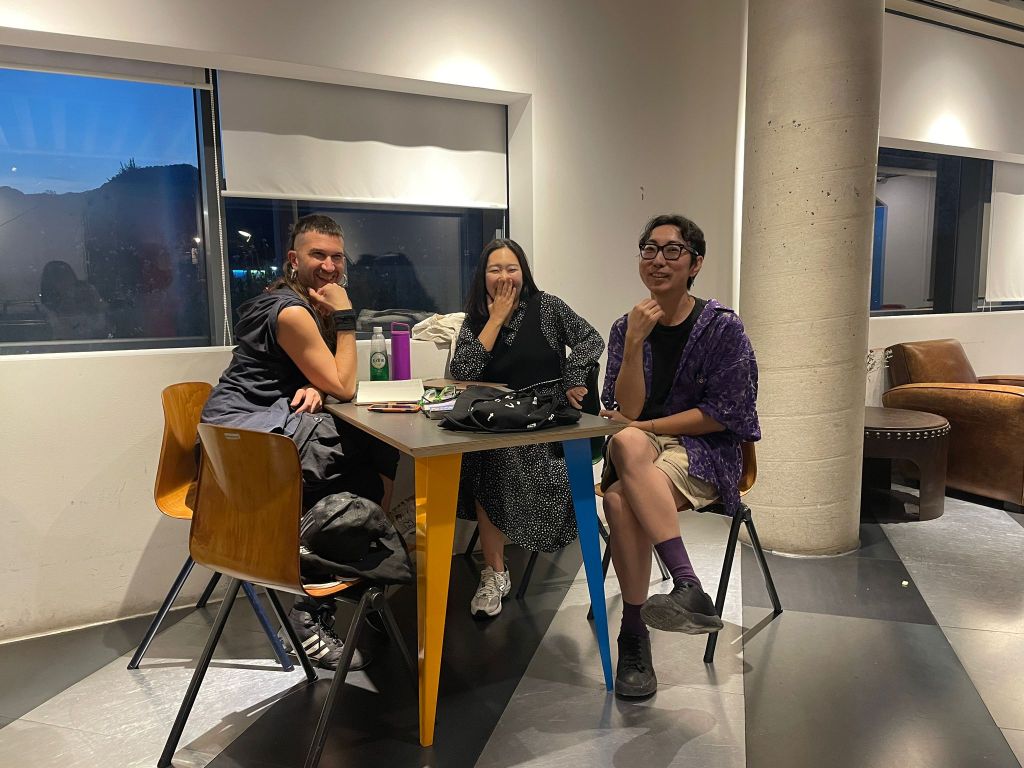
I am a curator of a Collaborative Artistic Research Project supported by the Canada-Korea Connections Fund the Canada Council for the Arts, with [M] Dudeck (Canada | Italy) and Dew Kim (South Korea). We have also been selected for the Canada-Korea Co-Creation Fund 2024. Both [M] Dudeck and Dew Kim’s visual art and performance practices revolve around the themes of queerness, spirituality, and religion. We explore the convergence of queer spiritual practices in the age of advanced technology, as well as a cross-cultural discussion on cultural negotiations involved in queering artistic practices. As a collective, we forge our path, crafting narratives and frameworks vibrant with techno-mediatic contemporaneity, yet always oriented towards a more equitable, and joyful future. As part of the project, [M] Dudeck visited Seoul for two weeks in Fall 2023, and the three of us engaged in a series of tours, dialogues, and meetings with cultural producers in Korea.
 Kyueun Kim