Performance and Virtual Reality (VR) Working Group (2022~ongoing)
In 2022, I co-founded and co-organized the inaugural Performance and Virtual Reality (VR) Working Group at the American Society for Theatre Research (ASTR) with Dr. Katherine Mezur (UC Berkley). In 2023, Laura Hyunjhee Kim (University of Texas at Dallas) joined us. We curated the working group as a laboratory to foster discussions about virtual/ immersive technologies, theatre, and performance. We sought experimental and daring research and practices from scholar-artists delving into the potential of VR as well as the possibilities of theatrical and performative interventions into current VR discourses. The group will be an ongoing and sustainable platform for idea sharing with the goal of producing an edited volume or online journal on the theme of performance and VR. As reflected in the theme of each year, we are interested in exploring the intersection of VR and the concept of “wild”—”Wild Sensorium” (2022), “Wild Hope” (2023), and “Wild Times and Wilderness” (2024).
Virtual Wilderness: Immersive Performances and Technologies in Wild Times (2024) – TBC
VR’s Wild Hope: Performance and Virtual Reality (VR) Working Group
Wild is a collective interaction with possibilities anchored and unanchored. It takes us to imaginaries that disconnect with real, live, and presence, a different unknown. What does “VR’s wild” do to hope? What does hope/lessness demand of VR? How do simulated realities, even if bound to an individual’s experience within the confines of the virtual, provoke empathy and human and non-human connections? For the complete rationale, please visit: https://www.astr.org/page/23_working_sessions#ws27
Catastrophe’s Bodies and Wild Sensorium: Performance and Virtual Reality (VR) Working Group
The inaugural Performance and VR Working Group will explore different arenas of VR as technological and artistic medium and examine how VR allows us to rethink the paradigms of here/there, self/others, and physical/virtual bodies through distant and intimate encounters with catastrophes. How does VR crack our corporeal “hearts” and shatter sense-making into inexhaustible layers of wild sensations? How does the virtual materialize experience? If catastrophe performs undoing and disordering, does VR have the potential to transform us into “wild things” (Jack Halberstam)? How do artists and creators employ VR systems to reimagine, rebuild, and rethink possible worlds in the aftermath/futures of disasters, like the pandemic, climate disasters, terror attacks, and wars? For the complete rationale, please visit: https://www.astr.org/page/22_WorkingSessions#ip5
Screening Performance, Performing Screens (2019)
was a co-organizer of the Doctoral Theatre Students’ Association (DTSA)‘s annual conference “Screening Performance, Performing Screens” with my colleagues at The Graduate Center, CUNY. The conference was a forum to reflect on the many collisions of theatre, performance, film, and other audiovisual media in scholarly, artistic, pedagogical, or performance-as-research works that engage with and challenge meanings of “screens”. The conference invited participants to think with the word “screen” both as noun and verb with three main questions:
- How can historical conceptualizations of screens help us broaden the concept beyond the context of new media and interactive technologies?
- How has engagement with and on screens expanded or reshaped production and distribution of art and knowledge?
- In what ways have reception(s), spectatorship(s), and the discourses of marginalization been molded by screens?
The conference featured papers, presentations, performances, and other forms of knowledge production by emerging scholars across the US (and beyond), with a keynote speech by Professor Sarah Bay-Cheng (USA) at the James Gallery, an evening performance by Edda Sickinger (Germany) at Segal Theatre, and all-day screenings.
Check the conference archive page to access the full program, information about the participants, and more.

2019 DTSA Conference Organizing Committee: Kyueun Kim, Mara Valderrama, Curtis Russell, Christine Snyder.
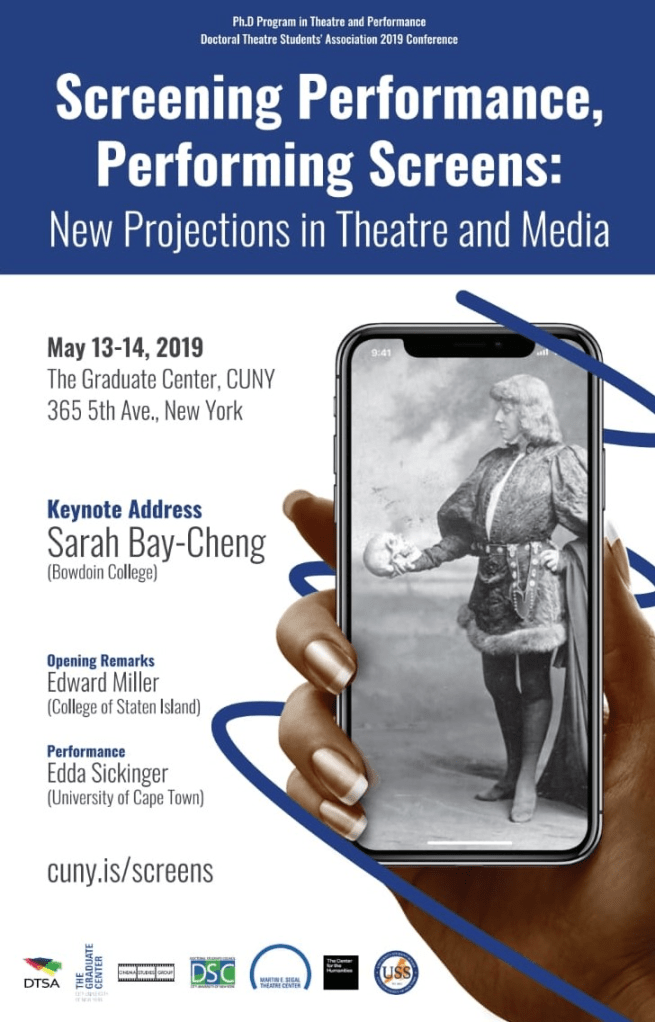
Conference Poster
About the DTSA: Doctoral Theatre Students’ Association (DTSA) is the recognized program student association for the Ph.D. Program in Theatre and Performance at the Graduate Center, CUNY. We are one of the largest graduate programs with a student body of diverse interests and backgrounds, and support each other on research, pedagogy, and artistic endeavors. Our annual conferences reflect the democratic organization and rich perspectives within the DTSA. Experimenting with various conference models in each iteration, these academic and artistic meetings catalyze our collective reflections on the current state of performing arts as well as the performances in the social. With overwhelming number of participants each year, we are building a unique community of scholars and practitioners who has joined us in the heart of New York City from across the world.
Performing Pedagogy, Engaging Technology (2019)
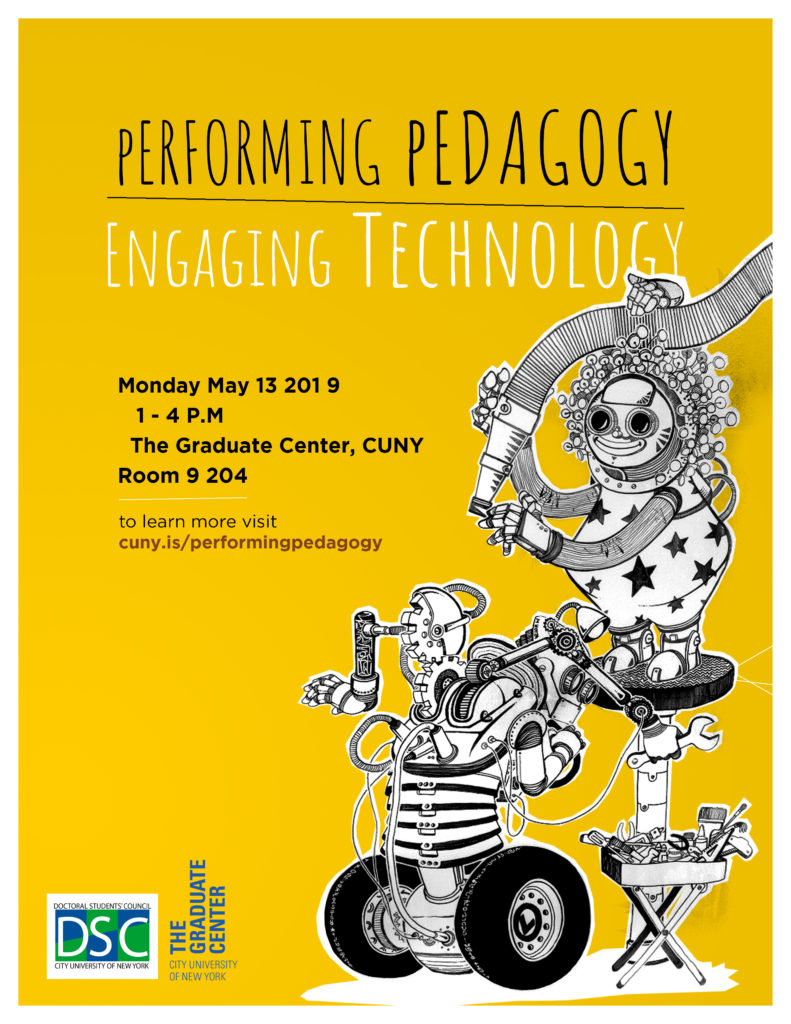
In 2019, I organized a conference “Performing Pedagogy, Engaging Technology” as part of my final project at the Interactive Technology and Pedagogy Certificate Program at The Graduate Center, CUNY. It was presented as a pre-conference at the Doctoral Theatre Student Association’s third annual conference Screening Performance, Performing Screens: New Projections in Theatre and Media, which I co-organized with my colleagues.
The conference invited doctoral theatre students and educators to discuss how we might learn from and adapt theatre and performance scholarship and pedagogy for the college classroom, especially focusing on the role of digital media technologies. The conference aimed to start conversations around the intersections of the scholarship of teaching and learning, digital humanities, and theatre and performance studies as they relate to such concepts as embodiment, immersion, affect, and experiential learning.
Professor Kimon Keramidas (NYU) delivered a keynote speech on “Re-composing the Ephemeral Past in Digital Media and Encouraging Creative Scholarship in the Performance Classroom.” I was in conversation with some projects on the intersections of art and digital platforms, including Ryan Donovan’s “Incorporating EdTech in the Arts Classroom,” Chloë Rae Edmonson’s “An Instagram Experiment in #Fashion and #Pedagogy,” Laura Cabochan’s “Process Drama as an Immersive Theatrical Classroom Experience,” and more.
Project Advisor: Professor Michael Mandiberg (ITP program coordinator)
Sponsor: Doctoral Students Council (DSC) Grant
Project Documentation: Click HERE to check out the conference program, the list of participants, and photos.
 Kyueun Kim
Leave a comment